

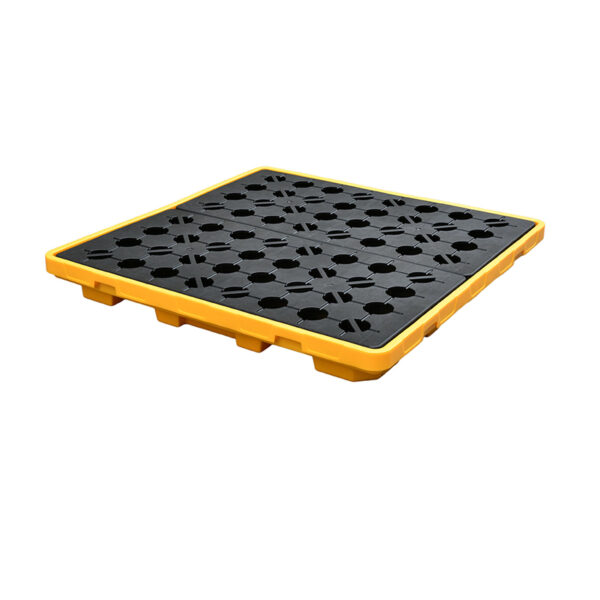
For overseas buyers, a 4-drum spill pallet is often the practical middle point between compact spill trays and larger IBC containment pallets. It gives enough footprint for standard chemical barrels and oil drums while keeping the storage point easy to load, clean, and inspect. The right model helps factories, distributors, and safety supply companies build a more complete spill containment range for warehouse customers.
When a 4-drum spill pallet is the right choice
Use 4-drum spill pallets when the storage area handles several drums in one fixed zone. Common applications include chemical warehouses, paint and coating storage, lubricant rooms, maintenance workshops, battery material storage, printing ink areas, and industrial cleaning chemical storage. The product is especially useful when buyers need a stronger base and a removable grating instead of a shallow tray.
If the project only stores small containers, compare tabletop spill trays. If the site handles drums but needs a lower profile, review drum spill trays. For regular barrel storage, the main category is drum spill pallets.
Check drum quantity, load, and sump design
A buyer should not choose by product size alone. Confirm the drum diameter, filled weight, liquid type, and daily handling method before requesting a quotation. A 4-drum spill pallet must support the expected load while leaving enough sump space below the deck to contain leakage. Removable grating is important because operators need access for cleaning, inspection, and liquid recovery after a spill.
For a direct product reference, review the 4-drum plastic containment pallet for chemical barrels. Buyers comparing several models can also check the 4-drum spill pallets category.
Match the pallet to warehouse handling
Export buyers should ask how the pallet will be moved on site. Some warehouses require forklift access, while others keep the containment pallet in one fixed safety zone. The floor condition, aisle width, drainage policy, and cleaning routine all affect the final selection. For heavier storage or larger liquid containers, an IBC spill pallet may be more suitable than a drum pallet.
Material choice also matters. HDPE and PP are common for spill containment products, but chemical compatibility should be checked against the actual stored liquid. If the end user handles aggressive chemicals, solvents, oils, or mixed industrial liquids, send the liquid list before confirming the order.
Prepare a useful RFQ for factory quotation
A good RFQ should include drum size, liquid type, total load, required quantity, destination port, packaging preference, color requirement, and whether OEM logo marking is needed. Importers and distributors should also mention whether the order is for direct factory use, resale stock, or a private-label catalog.
When buyers need a broader product range, a mixed shipment can include 4-drum spill pallets, smaller spill trays, drum spill trays, and IBC containment pallets. This helps overseas distributors test market demand without sourcing every model from different suppliers.
Common buying questions
Can one 4-drum spill pallet store oil drums and chemical barrels?
Yes, if the drum size, filled weight, and chemical compatibility match the pallet design. Buyers should provide the liquid type and drum dimensions before ordering.
Is a 4-drum spill pallet better than two smaller spill pallets?
It depends on the warehouse layout. A 4-drum pallet is efficient for one fixed storage zone, while smaller pallets may be easier to move or separate by chemical type.
Can overseas buyers request OEM colors or branding?
Yes. B2B buyers can discuss color, logo marking, packaging, and mixed-product sourcing with Zhenghao Plastics before confirming export orders.
Zhenghao Plastics supplies spill trays, drum spill pallets, 4-drum spill pallets, and IBC spill pallets for overseas distributors, importers, factories, and industrial safety buyers. Share your drum size, liquid type, quantity, and warehouse use case to receive a suitable recommendation.