
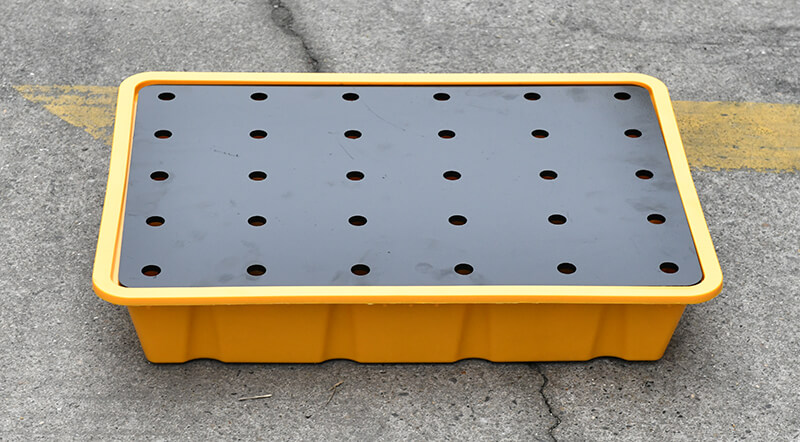
Buyers often search for a spill tray and a spill pallet at the same time because both products are used for secondary containment. They look similar in some applications, but they solve different handling problems. A spill tray is usually lower and simpler. A spill pallet is usually deeper, stronger, and designed for higher containment volume.
Choosing between them depends on the container size, the amount of liquid risk, and how workers use the storage area every day. Zhenghao manufactures drum spill trays, tabletop trays, drum spill pallets, and IBC containment products for different factory and laboratory layouts.
What Is a Spill Tray?
A spill tray is a low-profile containment product used below small containers, lab bottles, oil cans, or drums where access height matters. It helps catch drips during dispensing, temporary storage, filling, or maintenance work. Because it is lower than a standard pallet, workers can place and remove containers more easily.
For laboratories, workbenches, and small maintenance areas, a compact tray can be more practical than a large pallet. It takes less space and is easier to clean. If the liquid volume is small and the main concern is daily dripping, a tray is often the better starting point.
What Is a Spill Pallet?
A spill pallet is built for heavier drums, higher liquid volume, and more structured storage. It usually includes a removable grating over a sump. Drums sit on the grating, while leaks flow into the containment area below. This design is common for oil barrels, chemical drums, hazardous liquid storage, and warehouse staging.
For multiple drums, a 4-drum spill pallet gives the storage area a clearer and safer arrangement. It also makes inspection easier because the drums stay above the sump rather than sitting directly in spilled liquid.
Compare Access Height and Handling
Height is one of the most important differences. A tray keeps the container closer to the floor or workbench. This is useful when workers need to lift small containers by hand or pump liquid frequently. A pallet may be higher because it needs deeper containment volume and stronger support.
If the storage point is accessed many times per shift, choose the option that reduces handling effort. If the storage point is mainly for fixed drum storage, a deeper spill pallet may be more suitable.
Compare Sump Capacity
Sump capacity is where spill pallets usually have an advantage. A low tray catches smaller leaks and drips. A full spill pallet can hold more liquid and is better for larger containers. Before choosing a product, compare the container volume, number of containers, and any site requirement for secondary containment.
For projects involving a single lab container, a tray may be enough. For several 200-liter drums, a standard tray may be too shallow. In that case, review the drum spill pallet range instead.
Cleaning and Inspection
Both products should be easy to inspect. Removable grating is useful because workers can check the sump and clean it after a leak. Smooth internal corners and chemical-resistant plastic also reduce maintenance time. If the product will be used with sticky liquids or colored chemicals, ask whether the structure allows easy wash-down.
Simple Selection Rule
Use a spill tray when the container is small, the access height must stay low, and the expected liquid volume is limited. Use a spill pallet when the containers are heavier, the spill risk is higher, or several drums need organized storage in one containment area.
If you are not sure which model fits your layout, send container size, liquid type, and handling method to Zhenghao. We can compare tray and pallet options and recommend a practical model from our spill containment product range.